本文已被:浏览 169次 下载 738次
投稿时间:2025-01-30 修订日期:2026-01-15
投稿时间:2025-01-30 修订日期:2026-01-15
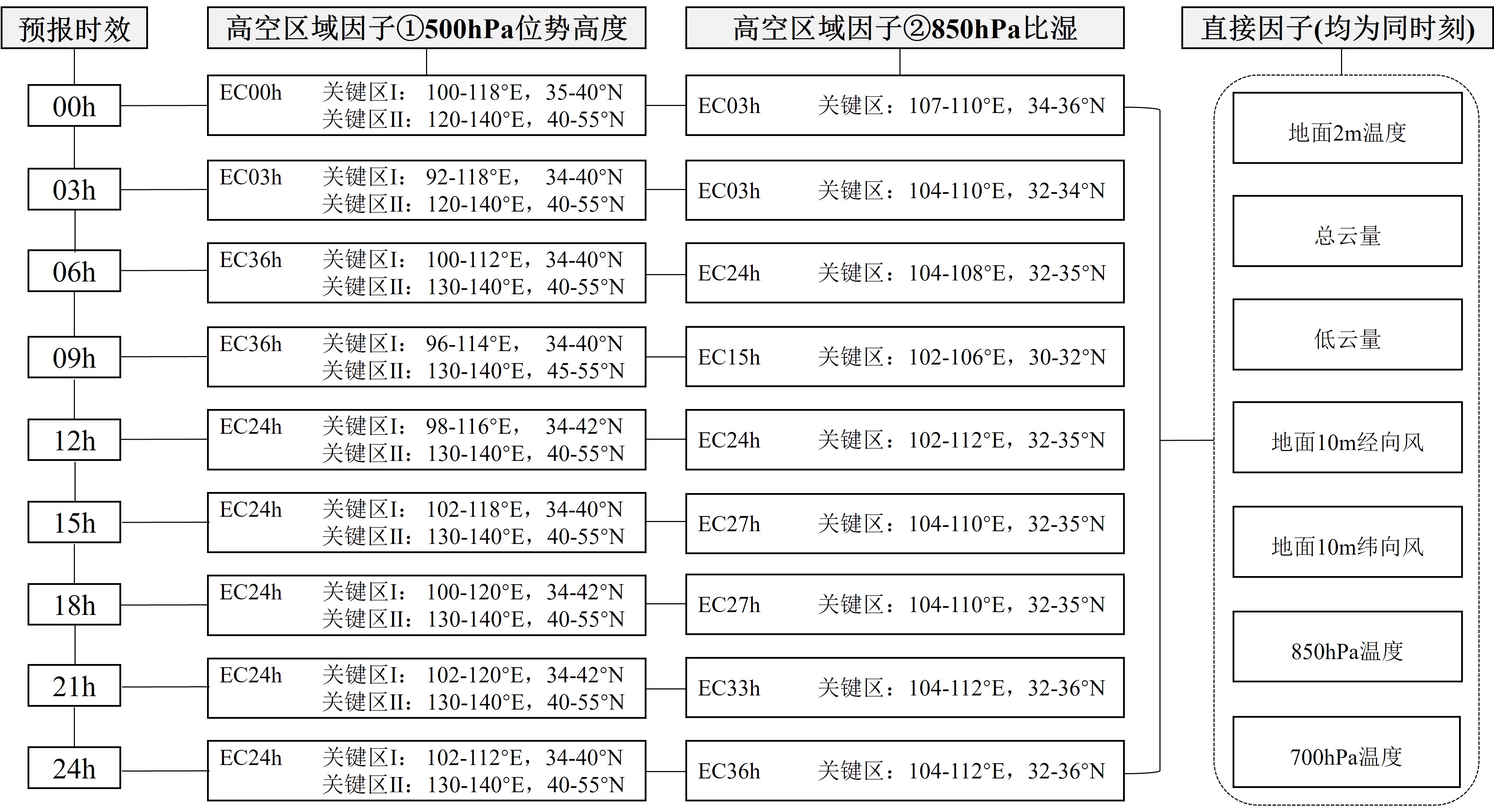
中文摘要: 利用2021—2024年欧洲中期天气预报中心(ECMWF)模式预报产品及西安城区站点2 m温度实况,针对西安关键点温度预报构建了多模型集成预报订正流程及方案。2021年9月1日至2023年12月31日数据作为训练集,用于因子筛选、参数调优与模型集成,2024年1月1日至4月30日数据作为测试集,用于评估数值模式及不同训练方案下模型的预报性能。通过主观经验筛选与时滞相关分析,优选了与温度变化密切相关的7个物理量以及不同时效高空关键区变量等特征因子,采用XGBoost、LightGBM、CatBoost梯度提升树模型进行单模型偏差订正,最终通过Stacking集成实现模型融合优化。结果表明: ECMWF模式对西安温度预报存在系统性冷偏差,夜间误差显著大于白天,降温、降水过程中冷偏差加剧。3种机器学习模型经贝叶斯优化调参后均能有效订正模式偏差(均方根误差分别降低了0.039、0.030、0.027℃)。优选特征因子后,单模型均方根误差平均降低约0.257℃。Stacking集成较传统加权集成表现更优,集成后均方根误差较后者降低了0.023℃,2℃误差内预报准确率提升了2.589%,在明显降温、降水天气过程中均方根误差较单模型最大减小0.481℃。
中文关键词: 气象保障,温度预报,机器学习,集成订正
Abstract:A multi-model integrated forecast correction process and scheme are constructed for 2 m temperature forecasts at Xi’an Station based on the 2021-2024 European Centre for Medium-Range Weather Forecasts (ECMWF) model forecasts and the 2 m temperature observations from Xi’an Station. The data from 1 September 2021 to 31 December 2023 are used as the training set for factor screening, parameter tuning, and model ensemble, while the data from 1 January to 30 April 2024 are taken as the test set to assess the forecast performance of numerical models and models trained under different schemes. Through subjective experience screening and time-lag correlation analysis, seven model forecasting physical variables closely related to temperature changes, as well as different lead time high level key zone variables and other characteristic factors get optimized. XGBoost, LightGBM and CatBoost are used for single model bias correction, and finally model fusion optimization is achieved through Stacking ensemble. The results show that ECMWF model exhibits a systematic cold bias in temperature forecasts at Xi’an Station, with the error being significantly greater at night than during the day and the cold bias intensifying during cooling and precipitation processes. After Bayesian optimization and parameter tuning, all the three machine learning models are able to effectively correct mode bias with root mean square errors (RMSE) reduced by 0.039℃, 0.030℃, and 0.027℃, respectively. Subsequent feature factor optimization further improves the single model forecast accuracy by approximately 0.257℃. The Stacking ensemble surpasses the traditional weighted ensemble. After ensemble, the RMSE of temperature forecasts is reduced by 0.023℃, and the forecast accuracy within 2℃ is improved by 2.589%. During the significant cooling and precipitation process, the forecast RMSE has a maximum reduction of 0.481℃ compared to that by the single model.
文章编号: 中图分类号: 文献标志码:
基金项目:中国气象局复盘总结专项(FPZJ2024-131)、中国气象局创新发展专项(CXFZ2025Q020)、秦岭和黄土高原生态环境气象重点实验室重点课题(2023K-2)、陕西省科技计划项目(2025JC-YBMS-331)和国家自然科学基金项目(42205037)共同资助
| 作者 | 单位 |
| 刘嘉慧敏 | 陕西省气象台,西安 710014 秦岭和黄土高原生态环境气象重点实验室,西安 710016 |
| 赵声蓉 | 国家气象中心,北京 100081 |
| 林建 | 国家气象中心,北京 100081 |
| 唐健 | 国家气象中心,北京 100081 |
| 王青霞 | 湖南省气象台,长沙 410118 |
| 尚可 | 西安航空学院,西安 710077 |
引用文本:
刘嘉慧敏,赵声蓉,林建,唐健,王青霞,尚可,2026.基于多种机器学习方法订正大城市温度精细化预报试验[J].气象,52(4):478-491.
LIU Jiahuimin,ZHAO Shengrong,LIN Jian,TANG Jian,WANG Qingxia,SHANG Ke,2026.Experimental Study on the Temperature Refined Forecasting in Large City Based on Multiple Machine Learning Methods[J].Meteor Mon,52(4):478-491.
刘嘉慧敏,赵声蓉,林建,唐健,王青霞,尚可,2026.基于多种机器学习方法订正大城市温度精细化预报试验[J].气象,52(4):478-491.
LIU Jiahuimin,ZHAO Shengrong,LIN Jian,TANG Jian,WANG Qingxia,SHANG Ke,2026.Experimental Study on the Temperature Refined Forecasting in Large City Based on Multiple Machine Learning Methods[J].Meteor Mon,52(4):478-491.