本文已被:浏览 163次 下载 93次
投稿时间:2025-08-23 修订日期:2026-07-04
投稿时间:2025-08-23 修订日期:2026-07-04
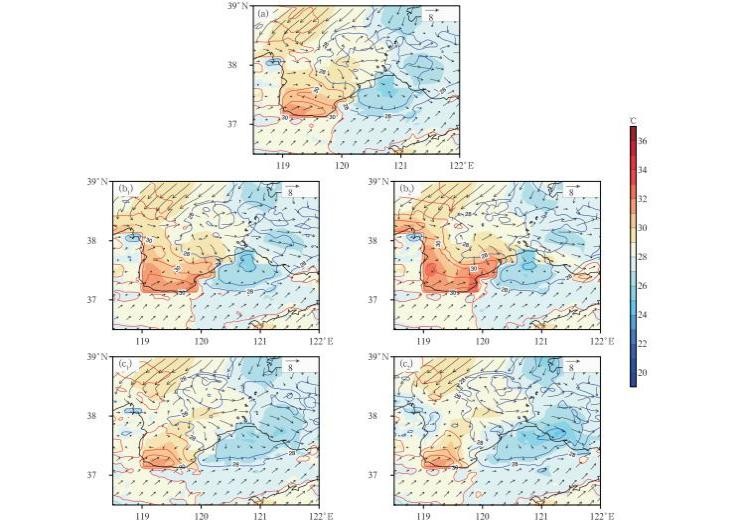
中文摘要: 针对2022年8月8日典型上岸对流风暴个例进行高分辨率数值模拟和敏感性试验,通过升高和降低黄渤海海温,探讨海温变化对上岸对流性降水强度的影响。结果表明:与控制试验相比,海温升高可使上岸对流性降水增强,其中海温升高1℃(2℃)时,沿岸区域平均累计降水量增加2.6 mm(15.7 mm),极值降水量增加38.2 mm(53.7 mm);当海温降低1℃(2℃)时,相应降水量减小3.7 mm(8.3 mm),极值降水量未受明显影响。分析原因发现:与控制试验相比,当海温升高2℃时,沿岸边界层温度梯度、风场辐合抬升以及对流有效位能和南移冷池的强度均明显增强,导致冷池前沿锋区及动力抬升明显增强,但当海温升高1℃时,边界层风场辐合和南移冷池强度未见明显增强,冷池前沿锋区及动力抬升增强不如升高2℃时显著;当海温降低1℃和2℃时,中尺度环境场及南移冷池强度均明显减弱,冷池前沿锋区不明显,动力抬升被大幅削弱,甚至转为下沉气流,最终导致上岸对流性降水强度减弱。本文研究结果可为上岸对流性降水预报提供参考。
中文关键词: 莱州湾,海温,上岸对流风暴,降水强度,数值模拟
Abstract:This study conducts a high-resolution numerical simulation and sensitivity experiments on a typical landing convective storm that occurred on 8 August 2022, and investigates the impact of sea surface temperature (SST) variation on the intensity of landing convective precipitation by increasing and decreasing the SST of the Yellow Sea and Bohai Sea. The results show that, compared with the control experiment, the increased SST can enhance the intensity of landing convective precipitation. When SST is raised by 1℃ (2℃), the average accumulated precipitation in the coast increases by 2.6 mm (15.7 mm) and the maximum precipitation increases by 38.2 mm (53.7 mm). When SST is lowered by 1℃ (2℃), the corresponding precipitation decreases by 3.7 mm (8.3 mm), but the maximum precipitation does not show any significant changes. Mechanism analysis indicates that, relative to the control experiment, a rise of 2℃ SST significantly strengthens the coastal boundary layer temperature gradient, wind convergence lifting, as well as the intensity of convective available potential energy and southward-moving cold pools, leading to pronounced reinforcement of the front zone at the cold pool leading edge and dynamic lifting. In contrast, a rise of 1℃ SST does not evidently enhance boundary layer wind convergence and southward-moving cold pool intensity, which results in weaker enhancement of the front zone and dynamic lifting than that under the condition of 2℃ SST increase. When SST decreases by 1℃ and 2℃, the mesoscale environmental conditions and southward-moving cold pool intensity weaken substantially. The front zone at the cold pool leading edge becomes indistinct, and dynamic lifting is greatly weakened or even transformed into downdrafts, ultimately reducing the intensity of landing convective precipitation. The findings of this paper can provide a theoretical references for the intensity forecasting of landing convective precipitation.
文章编号: 中图分类号: 文献标志码:
基金项目:国家自然科学基金面上项目(42375019)、中国气象局复盘总结专项项目(FPZJ2025-009)、东北冷涡研究重点开放实验室开放基金课题(2023SYIAEKFMS09)、福建省灾害天气重点实验室和中国气象局海峡灾害天气重点开放实验室开放课题(2024KFKT08)共同资助
引用文本:
邢蕊,章丽娜,熊秋芬,吴彬贵,汪澜,2026.海温对一次上岸对流风暴降水强度影响的数值模拟研究[J].气象,52(9):1051-1065.
XING Rui,ZHANG Lina,XIONG Qiufen,WU Bingui,WANG Lan,2026.Numerical Simulation Study on the Influence of Sea Surface Temperature on Precipitation Intensity of a Landing Convective Storm[J].Meteor Mon,52(9):1051-1065.
邢蕊,章丽娜,熊秋芬,吴彬贵,汪澜,2026.海温对一次上岸对流风暴降水强度影响的数值模拟研究[J].气象,52(9):1051-1065.
XING Rui,ZHANG Lina,XIONG Qiufen,WU Bingui,WANG Lan,2026.Numerical Simulation Study on the Influence of Sea Surface Temperature on Precipitation Intensity of a Landing Convective Storm[J].Meteor Mon,52(9):1051-1065.