本文已被:浏览 1154次 下载 698次
投稿时间:2025-05-30 修订日期:2026-04-22
投稿时间:2025-05-30 修订日期:2026-04-22
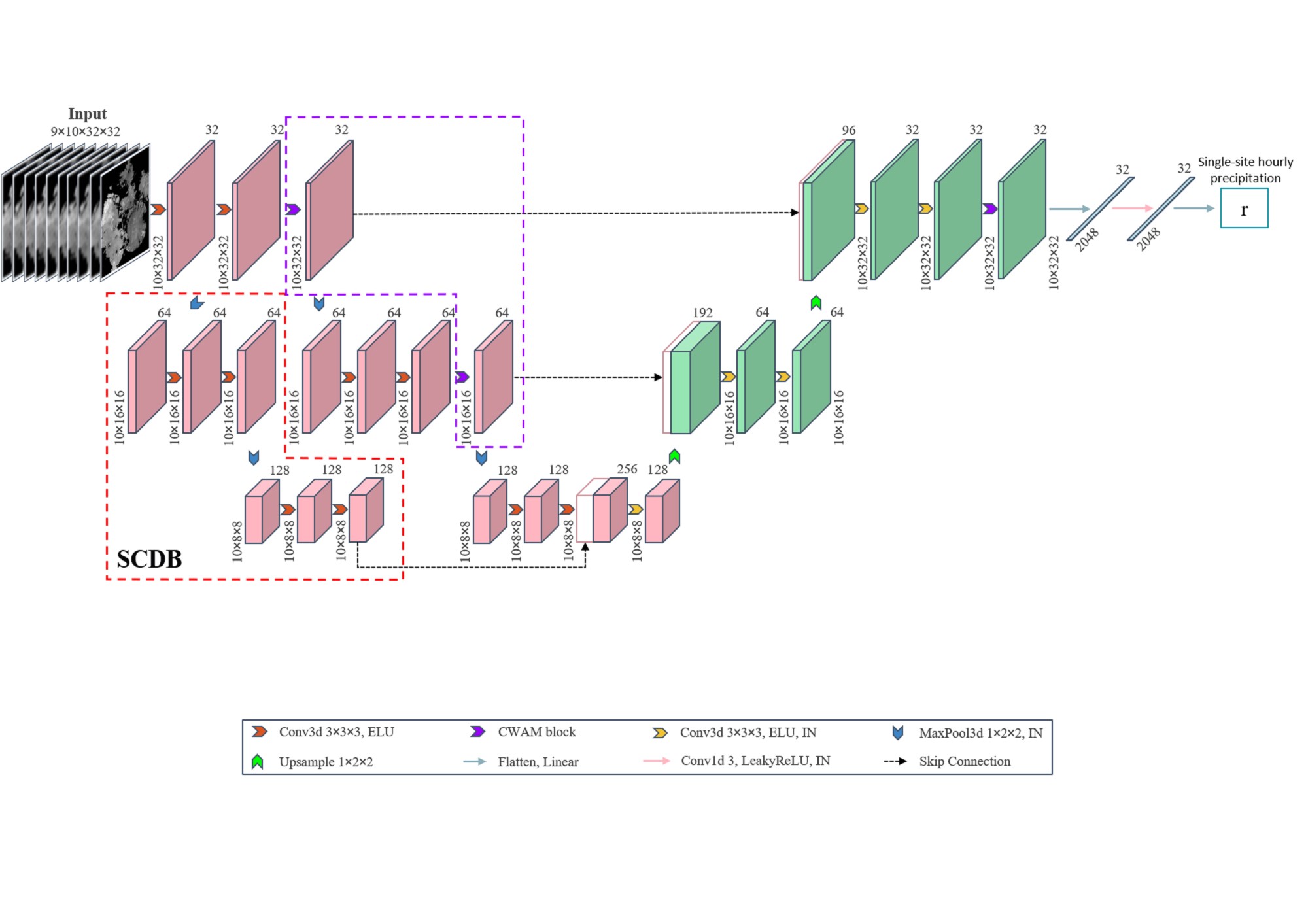
中文摘要: 当前基于深度学习的雷达反射率因子定量降水估计方法大多采用全局映射策略,这在一定程度上限制了模型对局部降水特征的解析能力,为此,本研究提出了一种双分支复合小波注意力网络模型(Dual-Branch Composite Wavelet Attention UNet,DCWA-UNet)。该模型主要从两个方面进行改进:设计了由主分支和简化卷积下采样分支构成的双分支编码器与特征聚合子网络的混合架构,实现了从雷达体扫数据到站点降水强度的端到端映射,从而构建出以站点为中心的样本体系。引入了复合小波注意力模块,通过多尺度特征分解和动态权重分配,增强模型对雷达回波的表征能力;同时采用加权均方误差损失函数,突出中高强度降水的梯度贡献。使用2019—2021年夏季四川盆地的降水地面观测与雷达观测资料,构建了一个包含4020个样本的数据集,用于模型训练和测试,并与SimVP等深度学习方法进行了对比。结果表明:DCWA-UNet在不同降水强度下均表现出明显的综合性能优势,在30 mm·h-1以下降水强度阈值下,其临界成功指数与平均绝对误差均提升显著。在[5, 10) mm·h-1降水强度下,DCWA-UNet的临界成功指数显著高于SimVP及其他对比模型,平均绝对误差相比SimVP降低了4.9%;在[10, 30) mm·h-1降水强度下,临界成功指数较SimVP提升了4.0%,平均绝对误差降低了4.0%,并且虚警率为所有对比模型中最低。
Abstract:Current deep learning-based QPE methods using radar reflectivity factors mostly adopt global mapping strategies, which to some extent limits the models’ ability to analyze local precipitation features. To this end, this study proposes a Dual-Branch Composite Wavelet Attention UNet (DCWA-UNet) model. The model is mainly improved from the following two aspects. Firstly, a hybrid architecture consisting of a dual-branch encoder (main branch + simplified convolutional downsampling branch) and a feature aggregation subnetwork is designed, which enables the end-to-end mapping from radar volume scan data to station precipitation intensity, thereby constructing a station-centered sample system. Secondly, a composite wavelet attention module (CWAM) is introduced to enhance the model’s representation capability for radar echoes through multi-scale feature decomposition and dynamic weight allocation. Meanwhile, a weighted mean squared error loss function is adopted to emphasize the gradient contribution of moderate-to-high precipitation. Using ground-based precipitation observation and radar observation data in the Sichuan Basin during the summers of 2019-2021, a dataset containing 4020 samples is constructed for model training and testing, and comparative experiments are conducted with deep learning models such as SimVP. The results show that DCWA-UNet achieves obvious comprehensive performance advantages under different precipitation intensities, with particularly significant improvements in critical success index (CSI) and mean absolute error (MAE) within the precipitation intensity below 30 mm·h-1. For precipitation intensities of [5, 10) mm·h-1, the CSI of DCWA-UNet is significantly higher than that of SimVP and other comparative models, and the MAE is reduced by 4.9% compared to SimVP; for precipitation intensities of [10, 30] mm·h-1, the CSI is improved by 4.0% and the MAE is reduced by 4.0% compared to SimVP. Moreover, the false alarm rate is the lowest among all comparative models.
文章编号: 中图分类号: 文献标志码:
基金项目:国家自然科学基金项目(42030611)、国家重点研发计划(2023YFC3007502)、四川省科技成果转移转化示范项目(2024ZHCG0026)和中国气象局气象干部培训学院科研项目-培育项目(2025CMATCPY06)共同资助
| 作者 | 单位 |
| 马星洪 | 成都信息工程大学计算机学院,成都 610225 |
| 钟琦 | 中国气象局气象干部培训学院,北京 100081 |
| 杨昊 | 成都信息工程大学计算机学院,成都 610225 |
| 陈敏 | 成都信息工程大学计算机学院,成都 610225 |
| 周航 | 成都信息工程大学计算机学院,成都 610225 |
引用文本:
马星洪,钟琦,杨昊,陈敏,周航,2026.基于双分支复合小波注意力网络的雷达定量降水估计[J].气象,52(6):713-725.
MA Xinghong,ZHONG Qi,YANG Hao,CHEN Min,ZHOU Hang,2026.Radar Quantitative Precipitation Estimation Based on a Dual-Branch Composite Wavelet Attention Network[J].Meteor Mon,52(6):713-725.
马星洪,钟琦,杨昊,陈敏,周航,2026.基于双分支复合小波注意力网络的雷达定量降水估计[J].气象,52(6):713-725.
MA Xinghong,ZHONG Qi,YANG Hao,CHEN Min,ZHOU Hang,2026.Radar Quantitative Precipitation Estimation Based on a Dual-Branch Composite Wavelet Attention Network[J].Meteor Mon,52(6):713-725.