本文已被:浏览 1557次 下载 1123次
投稿时间:2025-04-30 修订日期:2026-04-10
投稿时间:2025-04-30 修订日期:2026-04-10
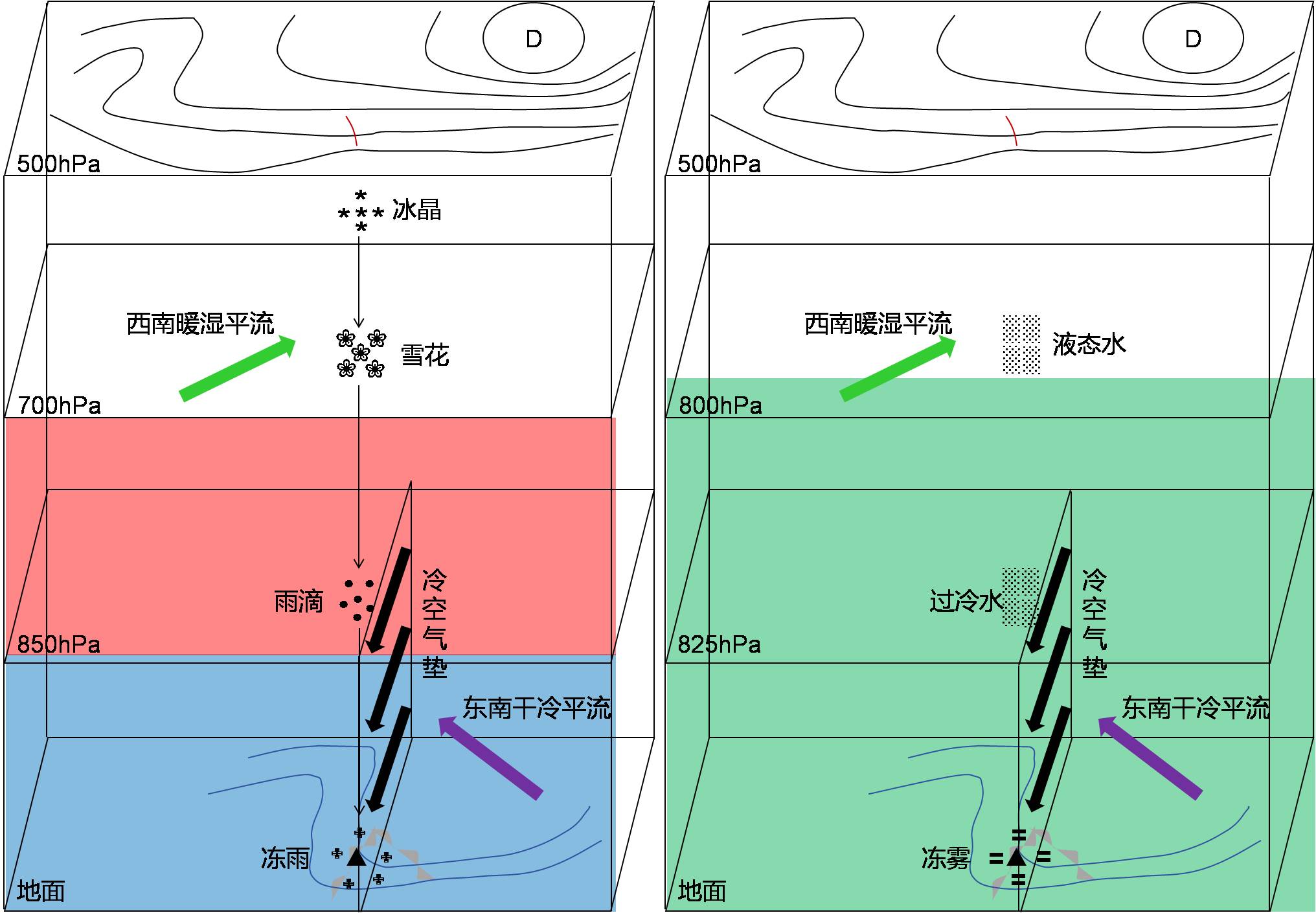
中文摘要: 2023年12月中旬,山西经历一次低温雨雪冰冻天气过程,其中13日山西南部垣曲县电线积冰给全县生活生产带来严重影响。利用常规气象观测、多普勒天气雷达和ERA5再分析资料,对此次严重致灾电线积冰过程的形成机制进行分析。结果表明:垣曲县致灾电线积冰属于雨雾混合凇类型,是前期短时间冻雨和随后长时间冻雾共同作用的结果,冻雾作用更为显著。500 hPa北支锋区中乌拉尔山高压脊前横槽和鄂霍次克海附近深厚冷涡稳定少动,横槽底前部短波槽快速东移影响山西,而南支锋区中700 hPa西南急流强盛,850 hPa东北—西南向冷槽位于华北上空,地面河套倒槽强烈发展与回流形势相互作用,西南暖湿气流沿着低层冷空气垫爬升,为垣曲冻雨和冻雾的形成提供了有利的大尺度环流背景。垂直方向上“上暖下冷”温度平流配置,使得温度从低空到高空呈现“冷-暖-冷”分布结构,且中层温度高于0℃而低层低于0℃,短波槽扰动产生的垣曲短时间冻雨属于融化机制。“上湿下干”湿度平流配置和下沉运动共同导致低层大气高度饱和,加之逆温持续,促使垣曲冻雾长时间维持,丰富的过冷却水滴先后经历两次快速增长,不断碰撞电线表面冰层,致使积冰不断增厚。东南气流沿喇叭口地形迎风坡抬升,也对电线积冰增厚起到一定的促进作用。
中文关键词: 电线积冰,雨雾混合凇,逆温,融化,冷空气垫
Abstract:In mid-December 2023, Shanxi Province experienced a weather event of low temperature, rain, snow and icing. On 13 December, wire icing occurred in Yuanqu County located in southern Shanxi, significantly disrupting people’s lives and production activities. Using conventional meteorological observations, Doppler weather radar data and the ERA5 reanalysis datasets, this paper investigates the formation mechanism of this serious disaster event caused by wire icing. The results show that this wire icing event in Yuanqu was of the mixed rime and glaze type, which was caused by the combined effects of short-duration freezing rain in the early stage and prolonged freezing fog in the subsequent period. Freezing fog played a more significant role than freezing rain. In the north frontal zone at 500 hPa, the horizontal trough in front of the high pressure ridge near the Ural Mountains and a deep cold vortex near the Sea of Okhotsk both remained stable with less movement. The short-wave trough ahead of the bottom of the horizontal trough moved rapidly eastward into Shanxi, while in the south frontal zone, the southwest jet stream at 700 hPa was strong. The cold trough in the northeast-southwest direction at 850 hPa was located over North China, and the surface inverted-trough in Hetao Area developed violently, interacting with the return-flow weather pattern. Besides, the southwest warm-humid airflow ascended along the low-level cold air cushion, providing a favorable large-scale circulation background for the formation of freezing rain and freezing fog in Yuanqu. The temperature advection configuration of “upper warming and lower cooling” in vertical direction led to a “cold-warm-cold temperature” structure in Yuanqu from low to high levels, with the mid-level temperature above 0℃ and the lower-level temperature below 0℃. The short-term freezing rain in Yuanqu, triggered by the short-wave trough, was attributed to the melting mechanism. The vertical humidity advection configuration of “wet above and dry at bottom”, coupled with sinking motion together made the lower atmosphere highly saturated. Additionally, temperature inversion continued in the lower atmosphere. These conditions collectively facilitated the long-term persistence of freezing fog in Yuanqu. Abundant supercooled water droplets that had two phases of rapid growth continuously impinged on the wire surfaces, causing ice accretion to become thickened progressively. Southeasterly airflow ascended along the windward slopes of the horn-shaped terrain, and also played a certain role in promoting the thickening of accretion on wires.
文章编号: 中图分类号:P458 文献标志码:
基金项目:山西省基础研究计划(202203021211080、202403021221338、202403021222496)、中国气象局复盘总结专项(FPZJ2025-017)和山西省气象局重点项目(SXKZDTQ20256329)共同资助
| 作者 | 单位 |
| 邱贵强 | 山西省气象台,太原 030006 |
| 赵桂香 | 山西省气象台,太原 030006 |
| 王扬 | 山西省气象台,太原 030006 |
| 卫甜 | 中国人民解放军63729部队,太原 030031 |
| 郝婧宇 | 山西省气象台,太原 030006 |
引用文本:
邱贵强,赵桂香,王扬,卫甜,郝婧宇,2026.山西垣曲一次严重致灾电线积冰形成机制分析[J].气象,52(5):608-620.
QIU Guiqiang,ZHAO Guixiang,WANG Yang,WEI Tian,HAO Jingyu,2026.Analysis on the Formation Mechanism of a Serious Disaster Process Caused by Wire Icing in Yuanqu, Shanxi Province[J].Meteor Mon,52(5):608-620.
邱贵强,赵桂香,王扬,卫甜,郝婧宇,2026.山西垣曲一次严重致灾电线积冰形成机制分析[J].气象,52(5):608-620.
QIU Guiqiang,ZHAO Guixiang,WANG Yang,WEI Tian,HAO Jingyu,2026.Analysis on the Formation Mechanism of a Serious Disaster Process Caused by Wire Icing in Yuanqu, Shanxi Province[J].Meteor Mon,52(5):608-620.