本文已被:浏览 3021次 下载 1258次
投稿时间:2025-02-27 修订日期:2025-07-29
投稿时间:2025-02-27 修订日期:2025-07-29
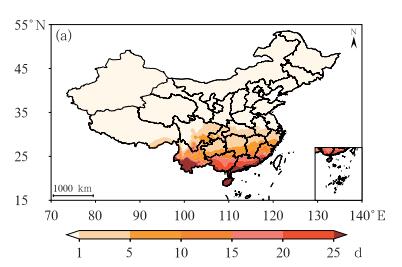
中文摘要: 中国春节假期一般在1月20日至2月26日之间,春节假期形成的大规模旅游客流呈现出以气候因素为主导的驱动模式。文章采用人体舒适度指数和趋势分析等方法,揭示了春节假期中国旅游气候的时空分布特征,并进一步分析了变化趋势。结果表明:1991—2020年春节假期,中国气候特征呈显著的南北差异,长江以南大部分地区平均气温在5℃以上,而黑龙江大部、内蒙古东北部在-15℃以下;降水主要集中在江南和华南中东部。春节假期华南大部及云南大部、四川南部人体舒适日数在10 d以上,有利于避寒旅游;东北大部、内蒙古中部和东北部、新疆北部积雪日数达15 d以上,有利于冰雪旅游。降水和雾为南方避寒旅游主要不利影响天气,而大风和寒冷天气则不利于北方冰雪旅游。1961年以来,春节假期华南东部、云南大部、四川南部等地人体舒适日数显著增多,同时降水日数减少,有利于避寒旅游;北方地区大风和寒冷日数减少明显,有利于冰雪旅游。总的来看,春节假期南方避寒和北方冰雪旅游气候条件整体呈趋好态势,这对于推动各地开展特色旅游服务和实现气候资源向旅游经济高效转化具有重要参考意义。
中文关键词: 春节假期,人体舒适度指数,避寒旅游,冰雪旅游,气候变化
Abstract:China’s Spring Festival is usually between 20 January and 26 February every year. The Spring Festival holiday is the golden week of tourism, bringing high tourism flow. The Spring Festival tourism shows climate-driven characteristics. In this paper, human comfort index and trend analysis method are used to analyze the spatial and temporal characteristics of favorable and unfavorable tourism climate conditions during the Spring Festival holiday in China. The results show that during the Spring Festival holiday from 1991 to 2020, there is a significant north-south difference for temperature and precipitation in China. The average temperature in most areas south of the Yangtze River (Jiangnan) is above 5℃, while that in most parts of Heilongjiang and northeastern Inner Mongolia is below -15℃. The precipitation is mainly concentrated in Jiangnan and the central eastern part of South China. The number of human comfort days is more than 10 days in most parts of South China, Yunnan, and southern Sichuan, beneficial for winter resort. The number of snow cover days is more than 15 days in the majority of Northeast China, central and northeastern Inner Mongolia, and northern Xinjiang, which is conducive to ice-snow tourism. Precipitation and fog mainly affect tourism in southern China, while strong winds and cold weather mainly affect that in northern China. Since 1961, during the Spring Festival holiday, the reduction of strong winds and cold days in northern China is conducive to holiday tourism, especially good for ice-snow tourism. In the eastern part of South China, most parts of Yunnan and southern Sichuan, the number of human comfort days has clearly increased while the number of rainy days has decreased, so the climate conditions for winter resort have been improved. Overall, the climate conditions for winter resort and ice-snow tourism during the Spring Festival holiday have shown good trends obviously, which is important for transforming climate resources into tourism economy and promoting the development of featured tourism in various regions.
keywords: the Spring Festival holiday, human comfort index, winter resort, ice-snow tourism, climate change
文章编号: 中图分类号:P461,P49 文献标志码:
基金项目:京津冀环境综合治理国家科技重大专项(2025ZD1208305)和国家自然科学基金项目(41875120)共同资助
| 作者 | 单位 |
| 赵珊珊 | 国家气候中心,北京 100081 |
| 高歌 | 国家气候中心,北京 100081 南京信息工程大学气象灾害预报预警与评估协同创新中心,南京 210044 |
| 李莹 | 国家气候中心,北京 100081 |
引用文本:
赵珊珊,高歌,李莹,2026.中国春节假期旅游气候空间格局及变化[J].气象,52(1):94-104.
ZHAO Shanshan,GAO Ge,LI Ying,2026.Spatial Patterns and Temporal-Variation Characteristics of Tourism Climate During the Spring Festival Holiday in China[J].Meteor Mon,52(1):94-104.
赵珊珊,高歌,李莹,2026.中国春节假期旅游气候空间格局及变化[J].气象,52(1):94-104.
ZHAO Shanshan,GAO Ge,LI Ying,2026.Spatial Patterns and Temporal-Variation Characteristics of Tourism Climate During the Spring Festival Holiday in China[J].Meteor Mon,52(1):94-104.