本文已被:浏览 6907次 下载 2910次
投稿时间:2025-10-08 修订日期:2025-11-12
投稿时间:2025-10-08 修订日期:2025-11-12
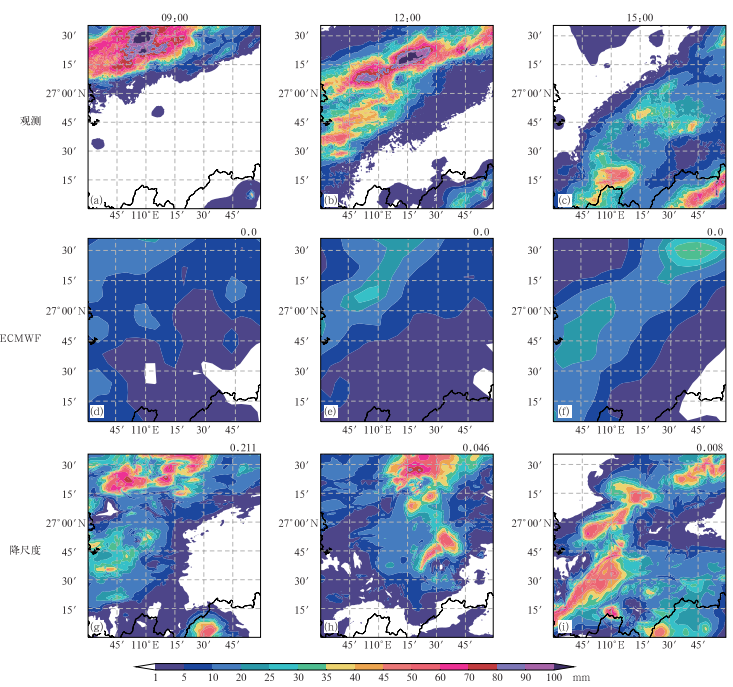
中文摘要: 近年来,数字智能天气预报业务快速发展,其传统技术方法在非线性误差订正、时空降尺度、多源数据融合等方面存在局限。深度学习技术凭借非线性拟合和模式识别能力逐步被引入数字智能预报流程。本文阐述了深度学习技术在数值模式偏差订正、高分辨率降尺度、多源异构数据融合、灾害性天气预报(以台风为例)和数据驱动天气预报五个方面的代表性技术成果。研究表明:深度学习模型可显著提高预报精度,包括学习预报与观测之间复杂的非线性关系以校正系统偏差,利用生成对抗网络细化降水结构以提升强降水预报技巧,融合雷达、卫星和模式数据以延长强对流临近预报时效,以及构建数据驱动模型实现以秒级速度产生与数值模式相当精度的预报。例如,“风雷”模型示范了生成式方法在强对流短时临近预报中的优势(对≥50 dBz回波命中率提高约30%),“风清”模型实现了 15 d全球预报业务准入和应用。深度学习的引入正推动智能预报产品在时空分辨率、不确定度定量化等方面取得进展。与此同时,文章也指出当前深度学习应用在样本体量、可解释性、极端事件预报、跨尺度一致性和计算成本等方面仍面临挑战,在未来研究中需要予以关注和改进。展望未来,应加强大样本/再预报资料建设,融合物理先验约束以提高模型可解释性与稳定性,针对极端天气引入尾部加权训练等技术以增强预报可靠度,设计跨尺度协同的模型框架以确保不同时间和空间尺度预报的一致性,并优化模型训练和推理的效率以满足业务时效要求。深度学习与数值模式的有机结合、优势互补,将成为推动数字智能预报进一步发展的重要方向。
Abstract:Digital intelligent weather forecasting has grown rapidly in global meteorological operations in recent years, yet conventional methods face inherent limitations in nonlinear error correction, spatial and temporal downscaling, and multi-source data integration. Deep learning, with its exceptional nonlinear approximation and pattern recognition capabilities, has emerged as a transformative tool in digital intelligent forecasting workflows. This paper presents representative advances and achievements of deep learning in five key areas: numerical weather prediction (NWP) bias correction, high-resolution downscaling, heterogeneous multi-source data fusion, hazardous weather prediction (exemplified by typhoons), and datadriven weather forecasting. The results show that deep learning models can substantially enhance forecast accuracy by learning complex forecast-observation relationships end-to-end to correct systematic biases, employing generative adversarial networks to refine precipitation structures and improve heavy rainfall prediction skill, integrating radar, satellite, and model data to extend severe convective weather nowcasting lead times, and developing data-driven models that generate forecasts in seconds with accuracy comparable to numerical models. Notably, the Fenglei model demonstrates the superiority of generative approaches in convective nowcasting (achieving about 30% improvement in hit rate for radar reflectivity ≥50 dBz), while the Fengqing model has been operationally implemented for 15 d global forecasting. Deep learning integration has been advancing intelligent forecast products in spatial and temporal resolution and uncertainty quantification. However, its current applications have persistent challenges including limited training samples, model interpretability, extreme event prediction, cross-scale consistency, and computational efficiency, all of which require further investigation in future’s researches. The research priorities in the future should be put on the following aspects: expand large-sample and reforecast datasets; incorporate physical constraints to enhance model interpretability and robustness; implement tail-weighted loss functions to improve the reliability of extreme weather forecasts; design cross-scale coherent frameworks to ensure consistency across scales; and optimize training and inference efficiency for operational requirements. The synergistic integration of deep learning and numerical modeling, with their complementary strengths, represents a pivotal pathway for advancing intelligent numerical weather prediction.
文章编号: 中图分类号: 文献标志码:
基金项目:国家自然科学基金联合基金项目(U2342217)、中国气象局重点创新团队智能预报技术团队项目(CMA2022ZD04)共同资助
| 作者 | 单位 |
| 代刊 | 国家气象中心,北京 100081 |
| 杨绚 | 国家气象中心,北京 100081 |
| 周康辉 | 国家气象中心,北京 100081 |
| 徐珺 | 国家气象中心,北京 100081 |
| 宫宇 | 国家气象中心,北京 100081 |
| 钱奇峰 | 国家气象中心,北京 100081 |
| 盛杰 | 国家气象中心,北京 100081 |
| 张小雯 | 国家气象中心,北京 100081 |
引用文本:
代刊,杨绚,周康辉,徐珺,宫宇,钱奇峰,盛杰,张小雯,2025.深度学习在数字智能天气预报中的应用[J].气象,51(11):1477-1494.
DAI Kan,YANG Xuan,ZHOU Kanghui,XU Jun,GONG Yu,QIAN Qifeng,SHENG Jie,ZHANG Xiaowen,2025.Application of Deep Learning in Digital Intelligent Weather Forecasting[J].Meteor Mon,51(11):1477-1494.
代刊,杨绚,周康辉,徐珺,宫宇,钱奇峰,盛杰,张小雯,2025.深度学习在数字智能天气预报中的应用[J].气象,51(11):1477-1494.
DAI Kan,YANG Xuan,ZHOU Kanghui,XU Jun,GONG Yu,QIAN Qifeng,SHENG Jie,ZHANG Xiaowen,2025.Application of Deep Learning in Digital Intelligent Weather Forecasting[J].Meteor Mon,51(11):1477-1494.