码上扫一扫!
“风顺”模型对中国盛夏气温候尺度预测技巧评估
刘俊杰,陆波,李昊,陈磊,仲晓辉,周辰光,胡家晖,吴捷,赵春燕,辛昱杭,赵阳,钱奇峰
(安徽省气候中心,合肥 230031; 安徽省大气科学与卫星遥感重点实验室,合肥 230031; 中国气象局气候预测研究重点开放实验室,国家气候中心/国家气候中心气候系统预测与变化应对全国重点实验室,北京100081; 南京信息工程大学气象灾害预报预警与评估协同创新中心,南京 210044; 雄安气象人工智能创新研究院 河北省气象人工智能重点实验室/复旦大学-雄安气象人工智能创新研究院地球系统人工智能预报联合实验室,雄安新区 070001; 复旦大学人工智能创新与产业研究院,上海 201203; 上海科学智能研究院,上海 200030; 新疆维吾尔自治区气候中心,乌鲁木齐 830002; 南京信息工程大学大气科学学院,南京 210044; 中国气象局气象干部培训学院,北京 100081; 浙江省气象科学研究所,杭州 310000)
Assessment of Pentad-Scale Prediction Skill of the Fengshun Model for Midsummer Temperature over China
LIU Junjie,LU Bo,LI Hao,CHEN Lei,ZHONG Xiaohui,ZHOU Chenguang,HU Jiahui,WU Jie,ZHAO Chunyan,XIN Yuhang,ZHAO Yang,QIAN Qifeng
(Anhui Climate Center, Hefei 230031; Anhui Key Laboratory of Atmospheric Science and Satellite Remote Sensing, Hefei 230031; CMA Key Laboratory for Climate Prediction Studies, National Climate Centre/State Key Laboratory of Climate System Prediction and Risk Management, National Climate Centre), Beijing 100081; Collaborative Innovation Center on Forecast and Evaluation of Meteorological Disasters (CIC-FEMD), Nanjing University of Information Science and Technology, Nanjing 210044; Hebei Key Laboratory of Meteorological Artificial Intelligence/FDU-XMetAI Joint Laboratory on Earth System Intellegent Prediction, Xiong’an Institute of Meteorological Artificial Intelligence, Xiong’an New Area 070001; Artificial Intelligence Innovation and Incubation Institute of Fudan University, Shanghai 201203; Shanghai Academy of Artificial Intelligence for Science, Shanghai 200030; Xinjiang Climate Center, Urumqi 830002; 9 School of Atmospheric Sciences, Nanjing University of Information Science and Technology, Nanjing 210044; CMA Training Centre, Beijing 100081; Zhejiang Institute of Meteorological Sciences, Hangzhou 310000)
本文已被:浏览 2547次 下载 1189次
投稿时间:2025-06-13 修订日期:2026-03-18
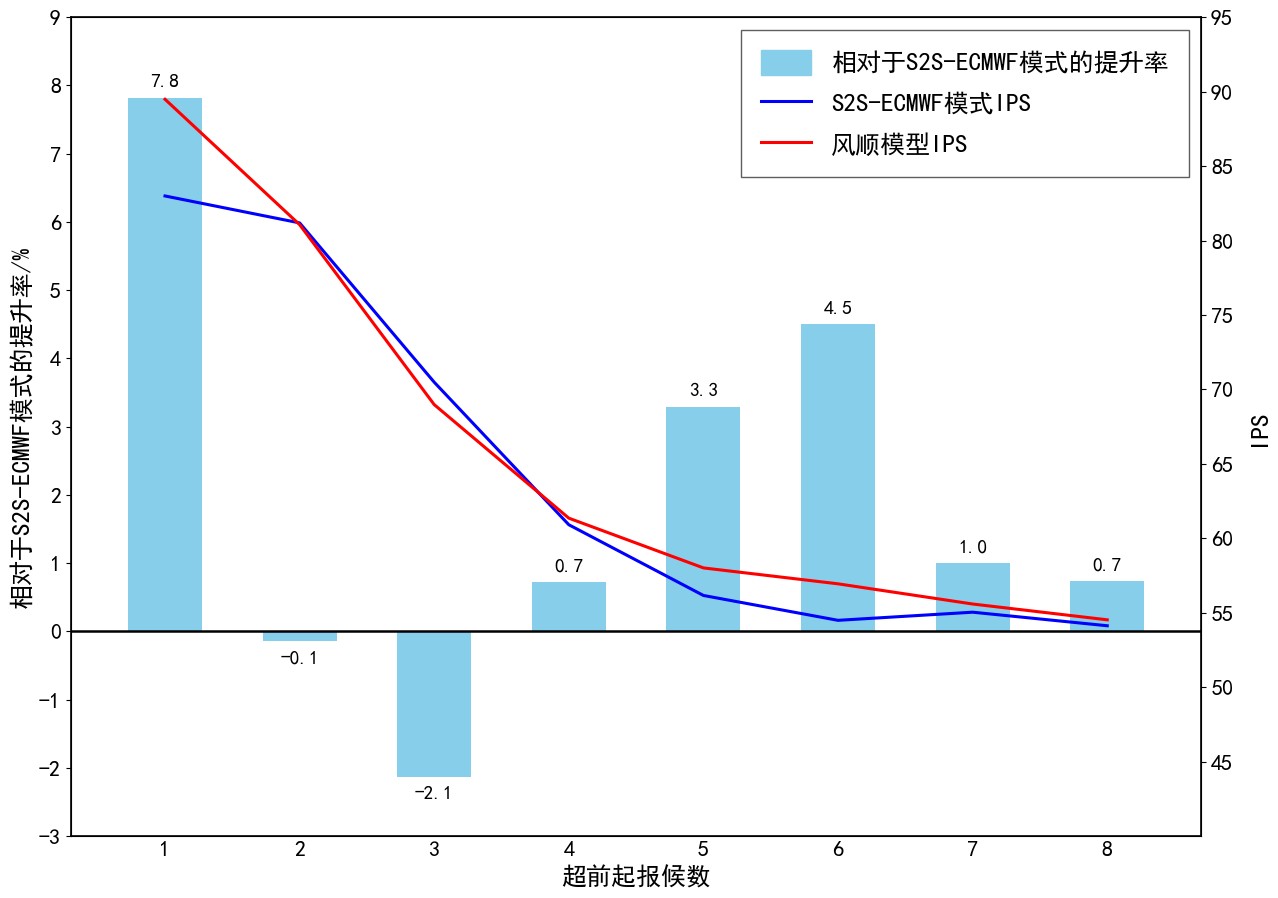
中文摘要: “风顺”是首个基于人工智能方法实现次季节至季节全球气候异常预测人工智能模型(以下简称风顺模型)。文章利用2017—2021年CMA-RA1.0和NCEP再分析数据以及站点观测数据,采用时间相关系数(TCC)、距平相关系数(ACC)、综合空间评分(IPS)等方法,对风顺模型和欧洲中期天气预报中心的延伸期至季节尺度预报模式(S2S-ECMWF模式)在中国盛夏(7—8月)气温候尺度预测技巧进行对比检验。不同数据源的检验结果基本一致,表明评估结果具有较好的稳健性。风顺模型对中国盛夏气温的候尺度预测总体性能优于S2S-ECMWF模式,TCC、ACC和IPS评分分别较其提高7.9%、18.4%和1.5%。在地域分布上,风顺模型在黄淮、江淮、华中、华南、华东和新疆等地的TCC技巧更高,而在东北地区、内蒙古、青藏高原和西南地区相对较弱。在预报时效上,风顺模型超前1候和4~8候的预测技巧优于S2S-ECMWF模式,其中超前6候的预测技巧最高(TCC、ACC和IPS分别提高42%、260%和4.5%),具有更长的预见期。这种优势主要源于风顺模型对亚洲中纬度地区500 hPa位势高度这一环流关键区异常特征的更好刻画。超前2~3候预测技巧相对较弱,可能与该时段大气初值信号衰减、下垫面信息作用不充分等因素有关,未来将通过引入多圈层下垫面信息以进一步提升预测性能。
Abstract:Based on the hindcast datasets from the Fengshun Model and the S2S-ECMWF Model, together with CMA-RA1.0 and NCEP reanalysis data and station observations during 2017-2021, the pentad-scale prediction skills of the Fengshun Model and the S2S-ECMWF Model for midsummer (July-August) temperature over China are comparatively verified. Three metrics of temporal correlation coefficient (TCC), anomaly correlation coefficient (ACC), and integrated prediction score (IPS) are adopted. The results are as follows. The verification results based on different reference datasets are generally consistent, demonstrating their good robustness. Overall, the Fengshun Model shows superior prediction skill to the S2S-ECMWF Model, with TCC, ACC and IPS values improved by 7.9%, 18.4%, and 1.5%, respectively. Spatially, the Fengshun Model exhibits higher TCC skill in the Huang-Huai (Yellow River-Huaihe River), Jiang-Huai (Yangtze River-Huaihe River), Central China, South China, East China, and Xinjiang regions, but showing relatively lower skill in Northeast China, Inner Mongolia, the Qinghai-Xizang Plateau, and Southwest China. Temporally, the Fengshun Model demonstrates superior prediction skill with 1 pentad and 4-8 pentad lead times, with the highest skill appearing at a 6 pentad lead time, and improvements in TCC, ACC and IPS can reach 42%, 260%, and 4.5%, respectively, which indicates an extended predictability window. This advantage is primarily attributed to the Fengshun Model’s better characterization of 500 hPa geopotential height anomalies over key circulation regions in mid-latitudes of Asia. However, the Fengshun Model shows a relatively weak prediction skill with 2 pentad to 3 pentad lead times, which is likely due to the decay of initial atmospheric signals and insufficient influence from underlying surface information. Future improvement focus will be put on incorporating multi-layer surface information to further enhance the Model’s prediction performance.
文章编号: 中图分类号:P425 文献标志码:
基金项目:国家自然科学基金气象联合基金项目(U2542210)、国家重点研发计划(2021YFA0718000)、中国气象局复盘总结专项(FPZJ2025-056、FPZJ2025-168)、华东区域气象科技协同创新基金合作项目(QYHZ202310)、中国气象局智能网格气候预测青年创新团队(CMA2024QN06)、数值预报统筹研发专项(TCYF2025QH004)和中国气象局气象能力提升联合研究专项(24NLTSZD03)共同资助
| 作者 | 单位 |
| 刘俊杰 | 安徽省气候中心,合肥 230031
安徽省大气科学与卫星遥感重点实验室,合肥 230031 |
| 陆波 | 中国气象局气候预测研究重点开放实验室,国家气候中心/国家气候中心气候系统预测与变化应对全国重点实验室,北京100081
南京信息工程大学气象灾害预报预警与评估协同创新中心,南京 210044
雄安气象人工智能创新研究院 河北省气象人工智能重点实验室/复旦大学-雄安气象人工智能创新研究院地球系统人工智能预报联合实验室,雄安新区 070001 |
| 李昊 | 复旦大学人工智能创新与产业研究院,上海 201203; 上海科学智能研究院,上海 200030 |
| 陈磊 | 复旦大学人工智能创新与产业研究院,上海 201203 |
| 仲晓辉 | 复旦大学人工智能创新与产业研究院,上海 201203 |
| 周辰光 | 中国气象局气候预测研究重点开放实验室,国家气候中心/国家气候中心气候系统预测与变化应对全国重点实验室,北京100081
南京信息工程大学气象灾害预报预警与评估协同创新中心,南京 210044
雄安气象人工智能创新研究院 河北省气象人工智能重点实验室/复旦大学-雄安气象人工智能创新研究院地球系统人工智能预报联合实验室,雄安新区 070001 |
| 胡家晖 | 中国气象局气候预测研究重点开放实验室,国家气候中心/国家气候中心气候系统预测与变化应对全国重点实验室,北京100081
新疆维吾尔自治区气候中心,乌鲁木齐 830002 |
| 吴捷 | 中国气象局气候预测研究重点开放实验室,国家气候中心/国家气候中心气候系统预测与变化应对全国重点实验室,北京100081
|
| 赵春燕 | 中国气象局气候预测研究重点开放实验室,国家气候中心/国家气候中心气候系统预测与变化应对全国重点实验室,北京100081
南京信息工程大学大气科学学院,南京 210044 |
| 辛昱杭 | 南京信息工程大学大气科学学院,南京 210044 |
| 赵阳 | 中国气象局气候预测研究重点开放实验室,国家气候中心/国家气候中心气候系统预测与变化应对全国重点实验室,北京100081
中国气象局气象干部培训学院,北京 100081 |
| 钱奇峰 | 中国气象局气候预测研究重点开放实验室,国家气候中心/国家气候中心气候系统预测与变化应对全国重点实验室,北京100081
浙江省气象科学研究所,杭州 310000 |
| Author Name | Affiliation |
| LIU Junjie | Anhui Climate Center, Hefei 230031
Anhui Key Laboratory of Atmospheric Science and Satellite Remote Sensing, Hefei 230031 |
| LU Bo | CMA Key Laboratory for Climate Prediction Studies, National Climate Centre/State Key Laboratory of Climate System Prediction and Risk Management, National Climate Centre), Beijing 100081
Collaborative Innovation Center on Forecast and Evaluation of Meteorological Disasters (CIC-FEMD), Nanjing University of Information Science and Technology, Nanjing 210044
Hebei Key Laboratory of Meteorological Artificial Intelligence/FDU-XMetAI Joint Laboratory on Earth System Intellegent Prediction, Xiong’an Institute of Meteorological Artificial Intelligence, Xiong’an New Area 070001 |
| LI Hao | Artificial Intelligence Innovation and Incubation Institute of Fudan University, Shanghai 201203; Shanghai Academy of Artificial Intelligence for Science, Shanghai 200030 |
| CHEN Lei | Artificial Intelligence Innovation and Incubation Institute of Fudan University, Shanghai 201203 |
| ZHONG Xiaohui | Artificial Intelligence Innovation and Incubation Institute of Fudan University, Shanghai 201203 |
| ZHOU Chenguang | CMA Key Laboratory for Climate Prediction Studies, National Climate Centre/State Key Laboratory of Climate System Prediction and Risk Management, National Climate Centre), Beijing 100081
Collaborative Innovation Center on Forecast and Evaluation of Meteorological Disasters (CIC-FEMD), Nanjing University of Information Science and Technology, Nanjing 210044
Hebei Key Laboratory of Meteorological Artificial Intelligence/FDU-XMetAI Joint Laboratory on Earth System Intellegent Prediction, Xiong’an Institute of Meteorological Artificial Intelligence, Xiong’an New Area 070001 |
| HU Jiahui | CMA Key Laboratory for Climate Prediction Studies, National Climate Centre/State Key Laboratory of Climate System Prediction and Risk Management, National Climate Centre), Beijing 100081
Xinjiang Climate Center, Urumqi 830002 |
| WU Jie | CMA Key Laboratory for Climate Prediction Studies, National Climate Centre/State Key Laboratory of Climate System Prediction and Risk Management, National Climate Centre), Beijing 100081
|
| ZHAO Chunyan | CMA Key Laboratory for Climate Prediction Studies, National Climate Centre/State Key Laboratory of Climate System Prediction and Risk Management, National Climate Centre), Beijing 100081
School of Atmospheric Sciences, Nanjing University of Information Science and Technology, Nanjing 210044 |
| XIN Yuhang | School of Atmospheric Sciences, Nanjing University of Information Science and Technology, Nanjing 210044 |
| ZHAO Yang | CMA Key Laboratory for Climate Prediction Studies, National Climate Centre/State Key Laboratory of Climate System Prediction and Risk Management, National Climate Centre), Beijing 100081
CMA Training Centre, Beijing 100081 |
| QIAN Qifeng | CMA Key Laboratory for Climate Prediction Studies, National Climate Centre/State Key Laboratory of Climate System Prediction and Risk Management, National Climate Centre), Beijing 100081
Zhejiang Institute of Meteorological Sciences, Hangzhou 310000 |
引用文本:
刘俊杰,陆波,李昊,陈磊,仲晓辉,周辰光,胡家晖,吴捷,赵春燕,辛昱杭,赵阳,钱奇峰,2026.“风顺”模型对中国盛夏气温候尺度预测技巧评估[J].气象,52(5):527-537.
LIU Junjie,LU Bo,LI Hao,CHEN Lei,ZHONG Xiaohui,ZHOU Chenguang,HU Jiahui,WU Jie,ZHAO Chunyan,XIN Yuhang,ZHAO Yang,QIAN Qifeng,2026.Assessment of Pentad-Scale Prediction Skill of the Fengshun Model for Midsummer Temperature over China[J].Meteor Mon,52(5):527-537.