本文已被:浏览 3267次 下载 1206次
投稿时间:2025-01-06 修订日期:2025-09-17
投稿时间:2025-01-06 修订日期:2025-09-17
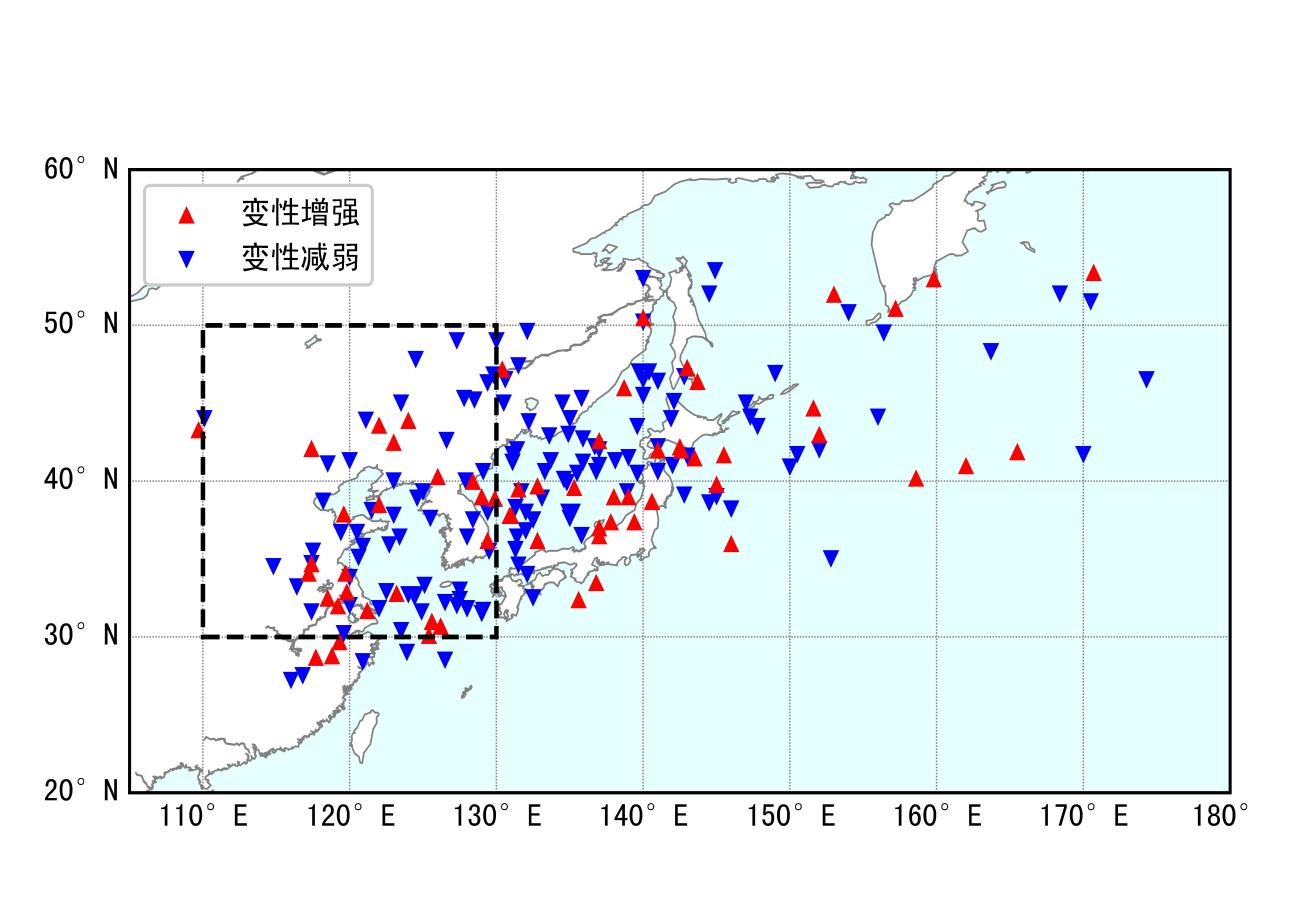
中文摘要: 利用中国气象局台风最佳路径数据,统计了1949—2020年进入黄渤海区域(30°~50°N、110°~130°E)台风(以下简称黄渤海台风)的气候特征。结果表明:年均有4.3个台风进入黄渤海区域,逐年黄渤海台风个数在西北太平洋台风中的占比呈现明显增加趋势,北上台风影响显著;黄渤海台风活动季为4—11月,从20世纪90年代开始出现向“秋季扩展”的趋势;黄渤海台风源地集中在5°~30°N、120°~160°E,近70年出现了连续向西迁移,以及80年代前逐步北移,90年代后伴随着“秋季扩展”南落的现象;远海路径进入黄渤海区域的台风最多,近海或登陆活动的转向、北上路径次之,登陆填塞、高纬西进或黄海西折路径相对较少;51.8%的黄渤海台风会发生变性,黄渤海变性台风中的28.6%在变性完成后至少会发生一次加强。变性加强过程主要发生在6—10月,其中8—9月最多,我国华东中南部和日本海南部周边为变性加强的两个集中发生地区。
中文关键词: 黄渤海区域台风,气候特征,源地,路径,变性
Abstract:Utilizing best-track data of typhoon provided by the China Meteorological Administration (CMA), this paper conducts an analysis of the climatic characteristics of typhoons (TCs) having entered the Huanghai and Bohai Sea Region (30°-50°N, 110°-130°E) from 1949 to 2020. The results indicate that, on average, 4.3 TCs enter the Huanghai and Bohai Sea (HBS) Region annually, showing a significant increasing trend in the percentage of HBS TCs in the western North Pacific typhoons (WNP TCs). HBS TCs are active between April and November. Since the 1990s, there has been an increase in HBS TCs activity during autumn. The primary genesis region for HBS TCs is located between 5°N to 30°N and 120°E to 160°E. Since the 1950s, it has been continuously shifting westward. Prior to the 1980s, there was a gradual northward trend, which was followed by a southward trend accompanied by the phenomenon of “autumn expansion” after the 1990s. Most HBS TCs enter the HBS via distant sea tracks, traveling a considerable distance from land. Then, there are HBS TCs that change direction or move northward during their offshore or landing activities. The other HBS TCs dissipate after landing, continue moving westward at high latitudes, or turn westward within the Yellow Sea. 51.8% of HBS TCs undergo extratropical transition, and among them, 28.6% strengthen after the transition. The intensification following extratropical transition mainly occurs from June to October, peaking in August and September. The central and southern regions of East China and the southern part of the Sea of Japan are the two main areas where such intensification is concentrated.
文章编号: 中图分类号:P467 文献标志码:
基金项目:山东台风与海洋创新团队项目(SDCXTD2021-2)、中国气象局创新发展专项(CXFZ2023J015)、华东区域气象科技协同创新基金合作项目(QYHZ202318)、山东省气象局重点项目(2023sdqxz11)和灾害天气国家重点实验室开放课题(2023LASW-B10)共同资助
引用文本:
张可,丛春华,2026.1949—2020年黄渤海区域台风特征分析[J].气象,52(1):44-55.
ZHANG Ke,CONG Chunhua,2026.Typhoon Characteristics in the Huanghai and Bohai Sea Region During 1949-2020[J].Meteor Mon,52(1):44-55.
张可,丛春华,2026.1949—2020年黄渤海区域台风特征分析[J].气象,52(1):44-55.
ZHANG Ke,CONG Chunhua,2026.Typhoon Characteristics in the Huanghai and Bohai Sea Region During 1949-2020[J].Meteor Mon,52(1):44-55.